|
| in 1926 |
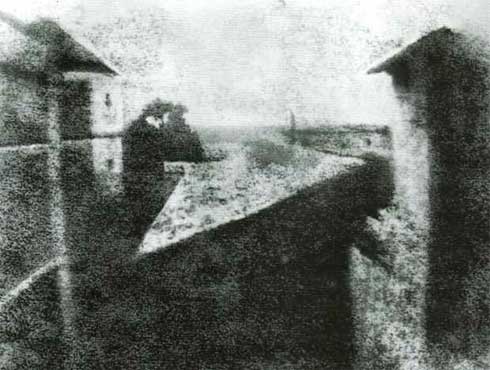
The first permanent
photography was an
image produced in 1826 by the French inventor
Joseph Nicéphore Niépce. His
photographs were produced on a polished pewter plate covered with a petroleum derivative called bitumen of Judea. Bitumen hardens with
exposure to light. The unhardened material may then be washed away and the metal plate polished, rendering a
negative image which then may be coated with ink and impressed upon paper, producing a print. On January 7, 1839 Daguerre announced that he had invented a process using silver on a copper plate called the
daguerreotype. The French government bought the patent and immediately made it public domain.
In 1832, French-Brazilian painter and inventor Hercules Florence had already created a very similar process, naming it
Photographie.
After reading about Daguerre's invention, Fox Talbot worked on perfecting his own process; in 1839 he acquired a key improvement, an effective fixer, from John Herschel, the astronomer, who had previously showed that hyposulfite of soda would dissolve silver salts. Later that year, Herschel made the first glass
negative.
By 1840, Talbot had invented the calotype process. He coated paper sheets with silver chloride to create an intermediate negative image. Unlike a daguerreotype, a calotype negative could be used to reproduce positive prints, like most chemical
films do today. Talbot patented this process, which greatly limited its adoption. He spent the rest of his life in lawsuits defending the patent until he gave up on photography . Later George Eastman refined Talbot's process, which is the basic technology used by chemical film cameras today. Hippolyte Bayard had also developed a method of photography but delayed announcing it, and so was not recognized as its inventor.
In 1839, John Herschel made the first glass negative, but his process was difficult to reproduce. Slovene Janez Puhar invented a process for making photographs on glass in 1841.
In 1847, Niépce St. Victor published his invention of a process for making glass plates with an albumen emulsion; the Langenheim brothers of Philadelphia and John Whipple of Boston also invented workable negative-on-glass processes in the mid 1840s
.
 |
| made in 1939 |
In 1851 Frederick Scott Archer invented the collodion process.
Herbert Bowyer Berkeley experimented with his own version of collodian emulsions after Samman introduced the idea of adding dithionite to the pyrogallol developer. Berkeley discovered that with his own addition of sulfite, to absorb the sulfur dioxide given off by the chemical dithionite in the developer, that dithionite was not required in the developing process. In 1881 he published his discovery. Berkeley's formula contained pyrogallol, sulfite and citric acid. Ammonia was added just before use to make the formula alkaline.
Nineteenth-century experimentation with photographic processes frequently became proprietary. Photographer Theodore Lilienthal successfully sought legal redress in an 1881 infringement case involving his "Lambert Process" in the Eastern District of Louisiana.
This information I find at wikipedia.org